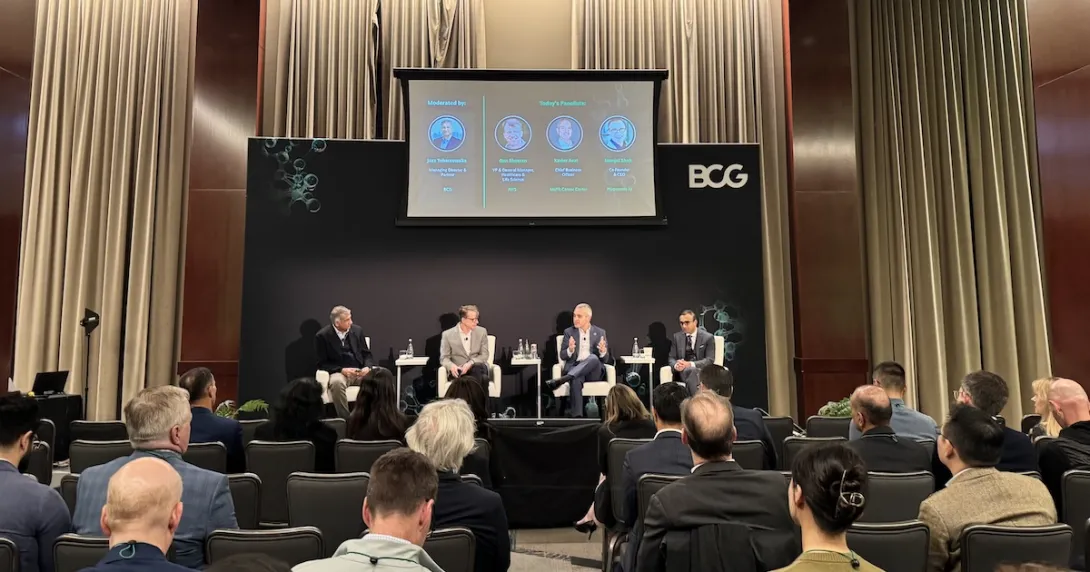
From left to right: Jazz Tobaccowalla of BCG, Dan Sheeran of AWS, Xavier Avat of Moffitt Cancer Center and Munjal Shah of Hippocratic AI
Photo: Jessica Hagen/MobiHealthNews
SAN FRANCISCO – At a Boston Consulting Group (BCG) event during the JPM Healthcare Conference, panelists discussed AI implementation in healthcare and where it has been making the most impact, both clinical and clinically adjacent.
Dan Sheeran, VP and general manager of healthcare and life science at AWS, said that most of the advances of AI within healthcare are largely in the non-clinical or clinical-adjacent areas, such as radiology.
"That's the early low-hanging fruit that we're seeing in AI, and then, of course, the big story in healthcare is the ambient scribing AI," Sheeran said.
Xavier Avat, chief business officer of Moffitt Cancer Center, said there is an opportunity to move the needle with AI, but it will come with challenges.
Avat said Moffitt is engaging with AI and is in an emerging stage, with the providers who are generally early adopters of technology being the health systems' primary testers.
Still, there is a need for more healthcare providers, and AI will help close that gap, the panellists said.
"On the clinical side, you need more personnel," Avat said. "AI has to become the solution pioneer."
Moderator of the panel and BCG Managing Director Jazz Tobaccowalla said it sounds like the health system is not focusing on reducing the workforce but rather on technology to improve productivity.
Munjal Shah, CEO and cofounder of Hippocratic AI, said there are not enough RNs graduating from nursing school to meet the needs of the aging population.
"We are either going to decide to have enough technology or people to service our seniors, or we are going to decide that we're not," Shah said.
"In Europe, I always joke now: You guys have one choice – you either got to let in immigrants or you gotta let in AI, and that first one is not going to so well for you."
Shah said this is always the story with new technology, though there are "doomers" who say it is not good for society.
"They are not right. They have never been right. They have zero track record. It's just that it's convenient," Shah said. " Healthcare is one of the few areas that can absorb this infinite abundance that AI can bring."
The clinical side is where the opportunities for measurable AI acceleration are the most tangible, AWS' Sheeran said.
"The clinical side is where the opportunities for measurable AI acceleration are the most tangible. And the reason is because clinical development is a highly structured, operationally consistent process that lends itself to many of the types of automation opportunities that AI can bring," Sheeran said.
When all opportunities from different customers, such as AWS' life sciences customers, are combined, Sheeran said, revenue increases substantially and patients get drugs faster.
Shah reiterated the benefits of having several partners, stating that one organization can help another through the data Hippocratic AI collects.
" We realized that because we serve providers, we serve payers and we serve life sciences, there's an interesting intersection," Shah said.
Shah said Hippocratic AI used data from health centers to tell its life sciences companies whether they should talk to that health system about conducting a specific clinical trial.
"All of this is very powerful," Shah said.