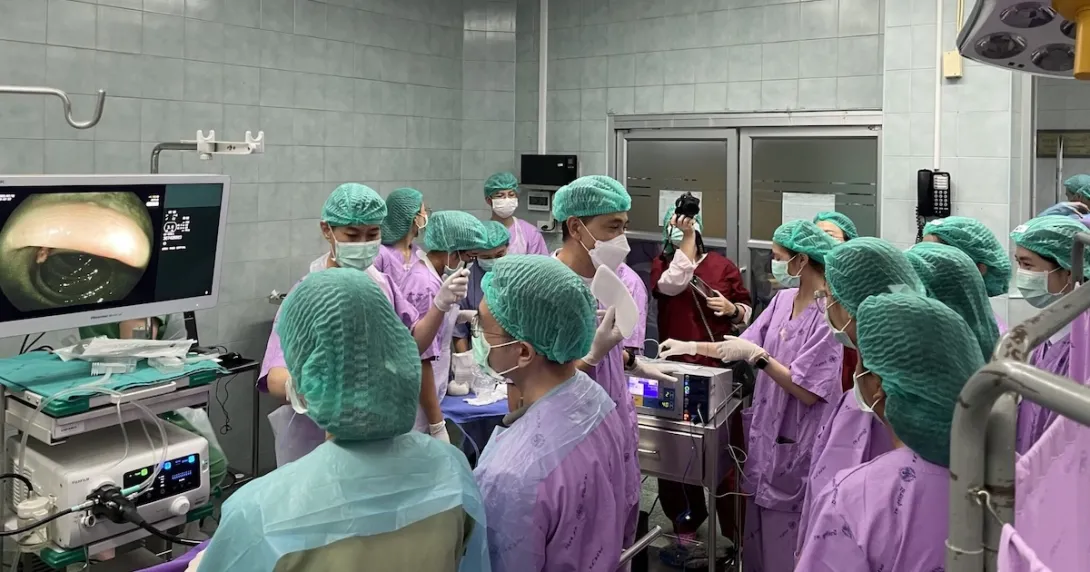
Photo courtesy of Chulalongkorn University
A multidisciplinary research team at Thailand's Chulalongkorn University is working to evolve its homegrown AI-powered tool for detecting colorectal polyps into a globally deployable computer-aided diagnosis platform, as it develops and validates the technology on gastrointestinal lesions over the next three years.
The project, called Deep GI (Deep Technology for Gastrointestinal Tracts), has now progressed into its third development phase, focused on building computer-aided diagnosis (CADx) capabilities that move beyond lesion detection to support real-time clinical decision-making. An initial CADx model has been developed and is being prepared for internal validation testing, according to Chula University, while clinical validation of the system's gastric and bile duct lesion detection capabilities continues under the project's second phase.
WHY IT MATTERS
In an interview with Mobihealth News, Dr Rungsun Rerknimitr, a Chula University professor who leads the Deep GI project, said the team is working on a three-year timeline to expand its training dataset and develop a clinically reliable CADx model before pursuing broader clinical deployment.
"This projection is based on a realistic assessment of the data acquisition process, institutional collaboration timelines, and rigorous validation requirements," he explained. "[By the end of this] three-year period, the team anticipates having a CADx model that is not only validated, but genuinely reliable – a model that clinicians can confidently use across diverse clinical settings with consistent, high diagnostic accuracy."
The primary goal of Deep GI Phase 3, Dr Rungsun said, is to "identify all forms of mature precancerous lesions and assist doctors in deciding immediately whether a lesion needs to be removed." The CADx system under development is designed to characterise and classify polyps directly during endoscopic examination, rather than simply flagging suspicious areas.
Deep GI was conceptualised to help close gaps in colorectal cancer screening in Thailand, where the disease ranks among the country's most common cancers. According to Chula University, only about 1,000 endoscopists currently serve a targeted screening population of roughly 15 million people aged 50 and older. This led researchers to use AI to support less-experienced doctors and general practitioners in achieving detection performance closer to that of specialists.
THE LARGER CONTEXT
In 2022, researchers from Chula's Faculties of Medicine and Engineering introduced Deep GI, an AI-assisted system that detects colorectal polyps and cancer in endoscopic images with reported accuracy of up to 97%. The AI detection system has since received approval from the Thai Food and Drug Administration for general colorectal cancer screening.
Later, the system was upgraded with CADx capability, enabling it to interpret endoscopic images at a level comparable to experts, and with greater accuracy than rookie endoscopists.
In 2025, the Deep GI team advanced the project into its second phase, extending its AI capabilities beyond identifying colorectal polyps to detecting gastric and bile duct lesions – an approach the researchers claim as a world first. Based on a validation study using additional gastric datasets, the AI demonstrated an overall accuracy of 86.56% in spotting gastric intestinal metaplasia, a precancerous lesion linked to gastric cancer.
Dr Rungsun mentioned that the team plans to secure regulatory clearances in Europe, the United States, and other Asian markets after completing a year of clinical validation and market establishment in Thailand. At present, Deep GI's regulatory approval is limited to general colorectal cancer screening; it has yet to apply for approval for gastric and bile duct detection.
"This staged commercialisation approach ensures that international expansion is supported by robust clinical data and regulatory compliance, positioning Deep GI as a credible, fully-compliant diagnostic tool in global markets," he explained.
Over the next three to five years, Dr Rungsun said the Deep GI team aims to deploy their technology in at least half of Thailand's government-based endoscopy centres, helping expand national colorectal cancer screening capacity toward an annual target of 1.5 million people. Deep GI is currently deployed and piloted in 35 local screening facilities, with funding support from Thailand's Board of Investment. Private hospitals would be able to adopt the technology through a Chulalongkorn University-backed startup.
Deep GI was initially trained using a supervised learning approach on "hundreds of thousands" of cancerous and non-cancerous endoscopic images from about 500 to 1,000 patients collected over several years at the Center of Excellence for Gastrointestinal Endoscopy at King Chulalongkorn Memorial Hospital. The system is deployed as an external hardware unit connected to endoscopic equipment, allowing it to retrieve and analyse images from any endoscope and return annotated visuals to clinicians in near real time.
To strengthen Deep GI's clinical robustness, the team is expanding its training datasets by collecting gastric images from multiple endoscopy centres across Asia-Pacific countries, with further plans to extend data acquisition to European and North American institutions. "This geographic diversification of training data will enable Deep GI to recognise and accurately classify gastric conditions as they appear in different populations and clinical settings, making the system more robust and clinically applicable worldwide," Dr Rungsun said.
Additionally, the Deep GI team is developing specialised training protocols using large datasets focused on certain GI lesions that are difficult to detect and classify, such as sessile serrated polyps. It also plans to incorporate a comprehensive image library of common benign gastric lesions into the training dataset to improve the system's ability to distinguish between malignant and non-malignant pathology and reduce diagnostic errors.